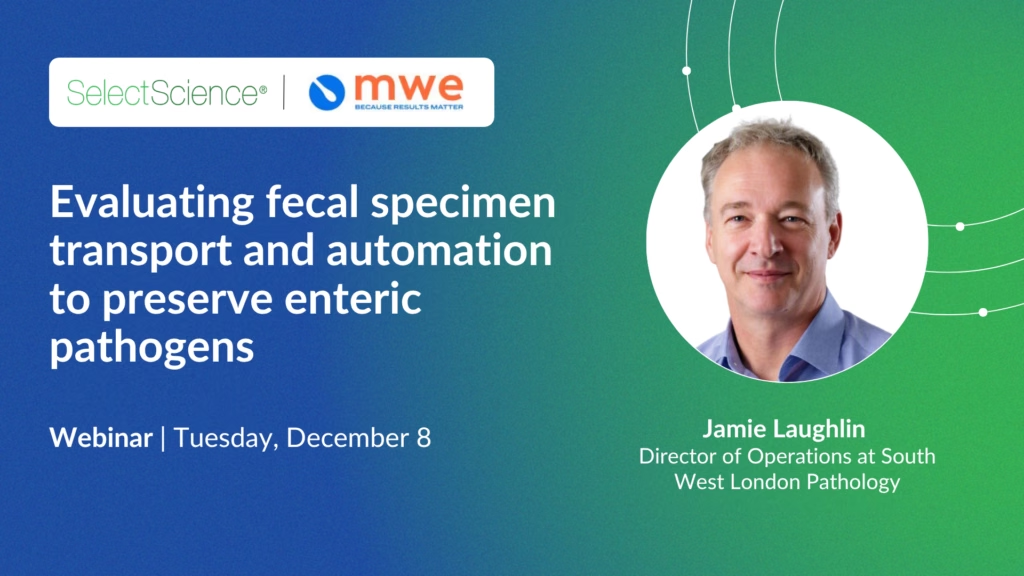
How do you ensure accurate gastrointestinal infection diagnosis before the fecal specimen reaches the analyzer?
It begins with a reliable sample. The way samples are collected, transported, stored, and processed can all have a significant impact on organism recovery, particularly as microbiology laboratories move towards increasingly automated workflows.
In an upcoming accredited SelectScience webinar, Jamie Laughlin, Director of Operations at South West London Pathology, will explore evidence-based approaches to preserving the viability of enteric organisms throughout specimen collection, transport, and pre-analytical processing.
Drawing on CLSI M40-A2 principles, Mr. Laughlin will examine how clinically representative fecal matrices, storage temperature, holding time, and laboratory automation can affect organism recovery and, ultimately, diagnostic reliability.
Attendees will also see findings from a comparative evaluation used as a practical case study, highlighting key considerations when assessing specimen collection and transport systems for gastrointestinal microbiology.
The case study includes the following organisms:
- Vibrio parahaemolyticus
- Enterococcus faecalis
- Escherichia coli
- Escherichia coli O157:H7
- Yersinia enterocolitica
- Salmonella Typhimurium
- Shigella flexneri
- Plesiomonas shigelloides
- Clostridium difficile
- Campylobacter jejuni
Join this SelectScience webinar to discover how robust pre-analytical preservation can help support reliable organism recovery, confident gastrointestinal diagnostics, and more streamlined microbiology workflows.
Have a question about this event? Get in touch